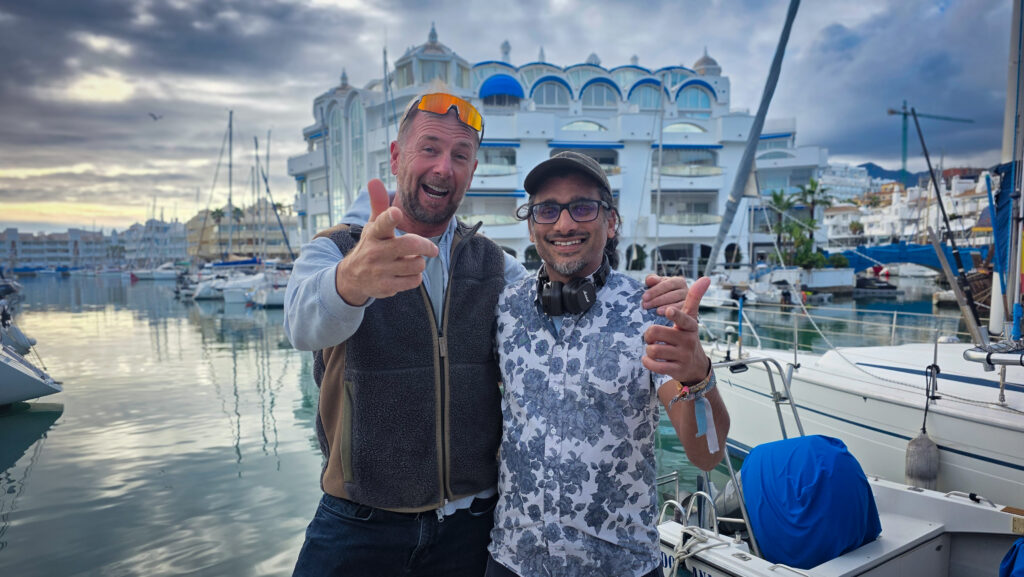
Pictured: Tim and I finally meeting in person in Andalucía, after six years of remote collaboration.
Documentary filmmaking often feels like an act of faith. You begin with a camera, an idea, and no guarantee that the pieces will come together. The Banjo Boys is a film shaped as much by chance encounters as by intention – a six-year journey built on serendipity, persistence, and resilience.
Where It All Began
The story starts on the streets of Lilongwe, where Yobu and Yosefe met. Despite the struggle around them, they managed to form a band, crafting instruments from found materials and honing their music through thousands of hours of performing. For street musicians, there are no rehearsals – only the act itself. Every performance is both the practice and the product. It’s not unlike the Beatles in Hamburg, where the gruelling schedule of playing night after night became their training ground, forging them into the band they would become.
Then came Neil. After meeting a random guy called Greg, who persuaded him to pack up and leave the UK, Neil followed his passion for music to Malawi. When these three met, something real began to take shape. The music had found its champion, and the catalyst that would propel the band beyond the borders of Malawi was activated.
The Film Takes Form
Years later, a singer-songwriter and a tech entrepreneur met at Liwonde National Park in Malawi. Neil and Tim Delhaes discussed the band and the possibility of turning their story into a film. That conversation became the scaffolding for what would eventually become a feature documentary.
After six years working together remotely, Tim and I finally met in person in Andalucía. It seemed better to just catch up rather than go into work mode. Whilst I’ve remained in Bournemouth throughout the collaboration, Tim is more like a rolling stone – his home has been Bali, Brazil, Uganda, Austria, Spain, and Chile over those six years.
Towards the end of last year, I was fortunate to meet three individuals who have shaped my career the most. Charles Werb, who normally lives in Dubai, was coincidentally in the UK and attended our world premiere at London Breeze Film Festival. Then I saw Rachel, from Rachel’s English, at the New York screening, who has been my biggest client to date. And finally, meeting Tim in person completed this sequence of meetings.
Professionalism vs. Mastery
I’ve been thinking a lot about Steven Pressfield’s The War of Art lately. In his section “We’re All Pros Already,” he outlines what defines us as professionals:
- We show up every day
- We show up no matter what
- We stay on the job all day
- We are committed over the long haul
- The stakes for us are high and real
Craft may take years to master, but professionalism is something we can quickly and easily bring into our work.
The Rice Question
Our biggest battle as a team was about how to fit in the fourth protagonist – a mysterious figure called Rice, something like the fifth Beatle. Rice left the band for various reasons, only to end up in prison. It’s a dramatic story that weaves into the film alongside Yobu, Yosefe, and Neil’s journey, but deciding how much space to give it, and where, tested us more than anything else in the edit. In the end, the film found its shape.
The Lesson
If there’s anything The Banjo Boys has taught me, it’s that serendipity rewards preparation. You can’t always manufacture the right meeting at the right time, but you can show up, stay open, and be ready when it happens. The film exists because a street musician met another street musician, because a stranger convinced someone to leave home, because a singer-songwriter and a tech entrepreneur met at a national park and forged an unlikely friendship, and because me and my brother managed to work together again, over a decade after our band broke up.
Sometimes the best thing you can do is keep going, stay professional, and trust that the story will find its way.
The Banjo Boys is a feature documentary directed by Johan Nayar and produced by Neil Nayar and Tim Delhaes. It continues its festival run with upcoming screenings at Oxford International Film Festival and Seeyousound in Turin.