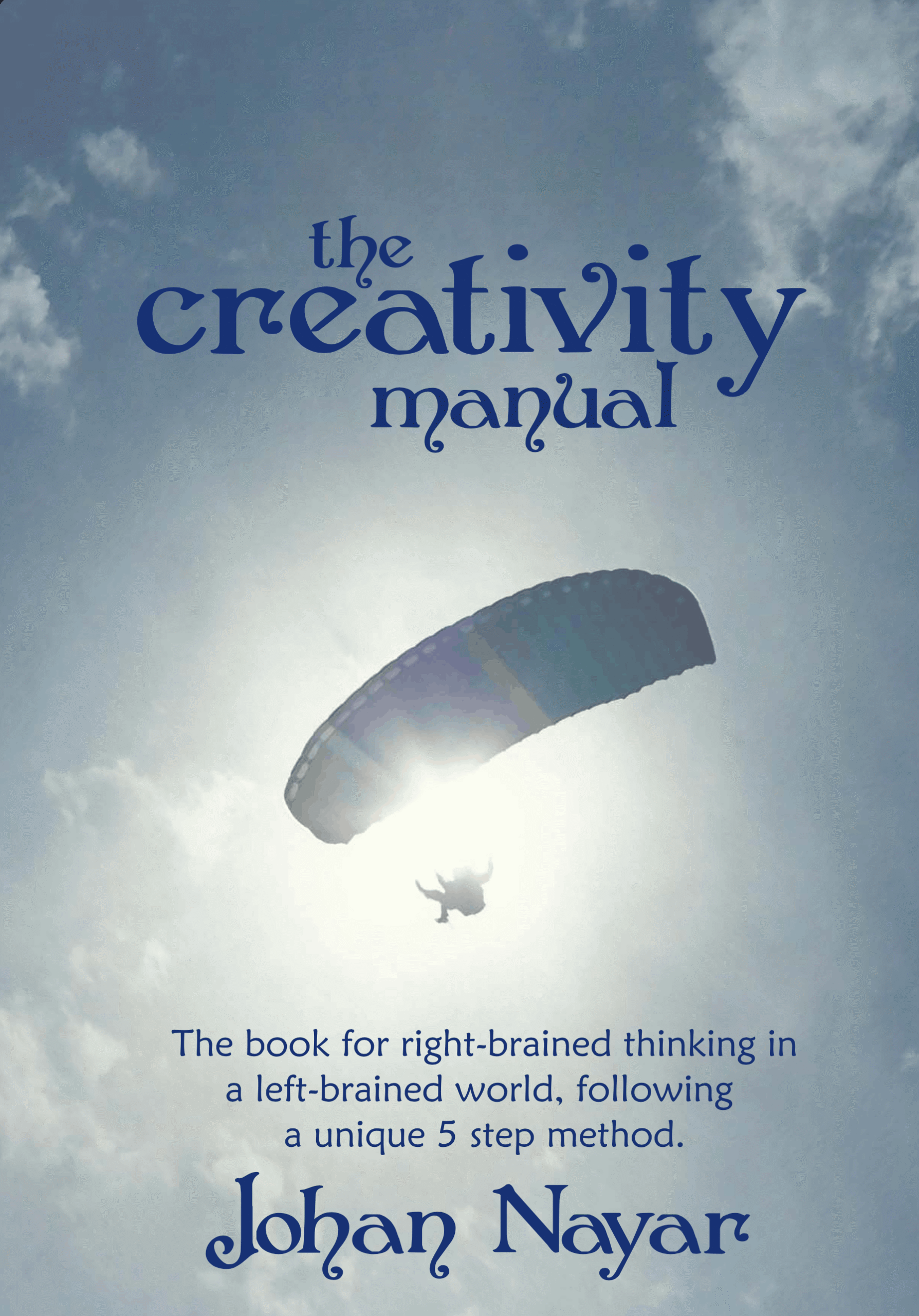
The Creativity Manual
A field-tested system for unlocking your creative potential. Born from a decade on the road through India, Nepal, and South America, combined with a master's thesis on the evolution of creativity.
The Five-Step Framework
This isn't just theory. It's a proven system for turning creative potential into consistent output—developed through years of coaching creative people and refined through rigorous academic research.
"Unlearning is more powerful than learning. Many filters placed on us by society serve only to restrict our highest potential. Recognising these programs is the first step to deleting them."
— From Chapter 3: Self-Discovery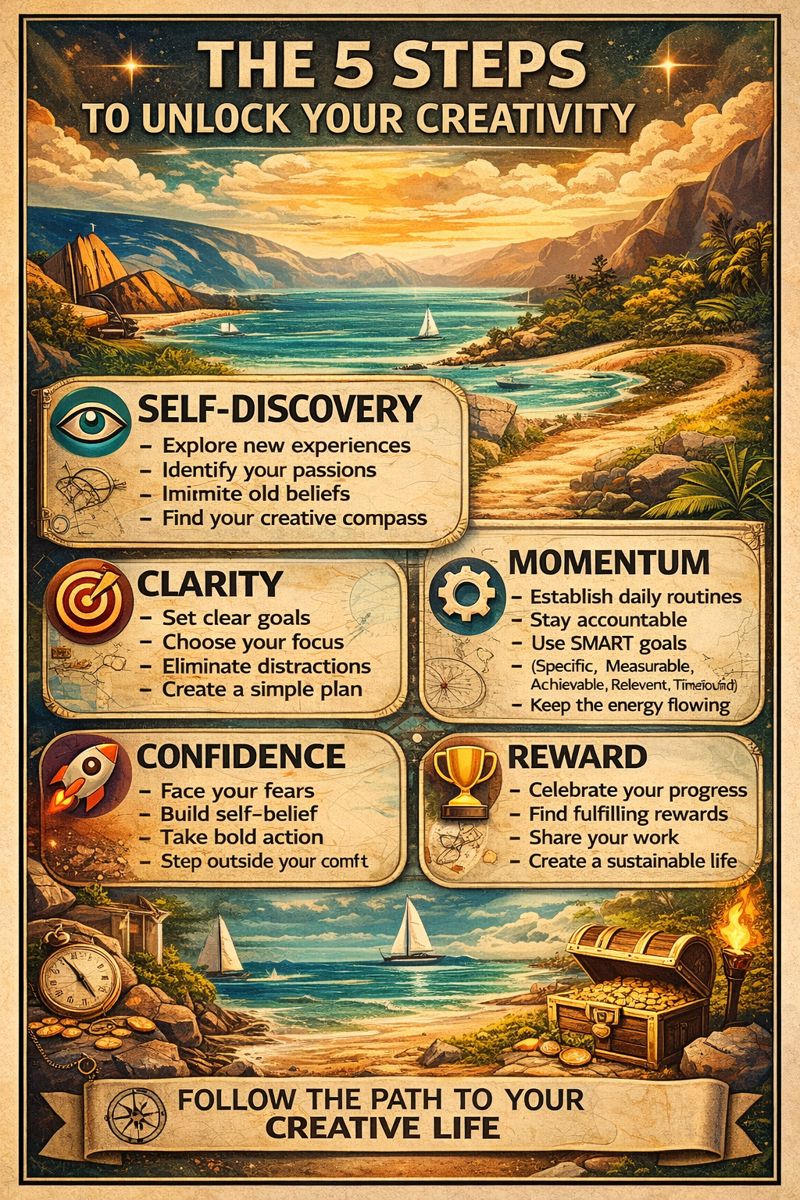
From Scattered Ideas to Finished Work
This book emerged from years on the road—through India, Nepal, South America—combined with a master's thesis on the evolution of creativity and a decade of coaching creative people.
It's not theory. It's a field-tested system for turning creative potential into consistent output.
Get the Book"The book will weave between the three great passions in my life which are psychology, travel and creativity which in combination lead to becoming a creative explorer."
— Johan NayarThe Five Steps to Unlock Your Creativity
A proven framework that takes you from uncertainty to sustainable creative output.
Self-Discovery
Find your signal through the noise. Expand your map of the world.
Clarity
Turn exploration into direction. Focus your energy like a magnifying glass.
Confidence
Act even when fear shows up. Step outside the comfort zone.
Momentum
Make creativity consistent. Build systems that carry you through.
Reward
Make it sustainable. Design rewards that reinforce progress.
Chapter by Chapter
Click each chapter to reveal deeper insights, key takeaways, and reflection questions to guide your creative journey.
Introduction
The pursuit of pure sensation—paragliding over the Himalayas at 19—set the stage for a decade-long exploration of what it means to live creatively. This chapter introduces the three pillars that weave through the book: psychology, travel, and creativity.
India smashed open a new way of thinking. The journey revealed latent abilities waiting to flourish—and showed that humans have such great potential when they step outside prescribed paths.
Key Takeaways
- Creativity is a process that can be developed, not a rare gift
- Travel and new experiences expand your "map of the world"
- The book bridges theory and real-world application
- Psychology, travel, and creativity combine to create a "creative explorer"
Questions to Reflect On
Evolutionary Psychology & Creative Animals
Why do humans create at all? This chapter explores the evolutionary origins of creativity through the lens of sexual selection and the handicap principle. From peacock plumage to bowerbird architecture, nature reveals that creativity is deeply wired into what we are.
The bowerbird creates elaborate structures purely to attract mates—an honest signal of good genes. Human creativity may have evolved for similar reasons, making art not a luxury but a fundamental drive.
Key Takeaways
- The handicap principle: costly displays signal genetic quality
- Creativity evolved through sexual selection, not just survival
- Both sexes in humans have creative potential (unlike many bird species)
- Understanding "why" we create helps unlock "how"
Questions to Reflect On
Self-Discovery — Theory
Self-actualisation sits at the top of Maslow's hierarchy—the highest potential of humanity. This chapter explores how to begin the journey inward: understanding your primary sense (visual, auditory, kinaesthetic), your Myers-Briggs type, and the conditioning that shapes your reality.
Unlearning is more powerful than learning. Many filters placed on us by society serve only to restrict our highest potential. Recognising these programs is the first step to deleting them.
Key Takeaways
- Your "map of the world" is your reality—expand it consciously
- Identify your primary sense (VAK) to understand how you process best
- Myers-Briggs gives insight into your personality type and blind spots
- Move from the "effect" side to the "cause" side of life
Questions to Reflect On
Self-Discovery — Real World
Arriving in Goa at dawn, following distant music to a beach valley painted in psychedelic colours—this was the beginning of de-conditioning. The road trip through India demolished old patterns and revealed that you hold the pen to your own story.
From learning to ride a motorcycle to an LSD experience overlooking a Kashmiri lake at sunset, these raw experiences upgraded the operating system and revealed states of perception that would later be accessed naturally.
Key Takeaways
- Travel breaks cyclic patterns that prevent progress
- New sensory experiences become part of your creative repertoire
- The four levels of learning: unconscious incompetence → conscious competence
- Peak experiences can serve as guides for possible states of being
Questions to Reflect On
Clarity — Theory
A world-class photographer with a world-class camera will lose to an amateur with a disposable camera if the professional can't use one function: focus. Clarity channels energy like a magnifying glass harnesses the sun to create flame.
Finding your niche is key—just as evolution favours species that slot into specific niches. Facebook started as a Harvard-only communication tool before expanding. Niche first, broaden later.
Key Takeaways
- Energy flows where attention goes—focus on what you want, not what you don't
- The unconscious mind doesn't hear negatives
- Animals in nature are rarely depressed—they have inherent purpose
- Finding a niche creates the best opportunities for creative success
Questions to Reflect On
Clarity — Real World
Understanding the fourth letter in Myers-Briggs (J for Judger vs P for Perceiver) transformed relationships and self-awareness. Js plan carefully; Ps keep options open. Neither is wrong—but knowing your type helps you work with others and develop your weaker side.
Creating a character called "Maze"—a hip-hop artist from L.A.—and going out in Oxford as that persona revealed how stepping into another personality type unlocks new possibilities and deeper empathy.
Key Takeaways
- Know your Myers-Briggs type and understand its opposite
- Create characters with different personality types to expand your options
- Stepping into someone else's shoes builds empathy and flexibility
- Combine your primary sense with your personality type for maximum self-knowledge
Questions to Reflect On
Confidence — Theory
The comfort zone is one of the greatest destroyers of creativity and success. Like Tyler Durden in Fight Club, we need experiences jarring enough to awaken us from consumer-based slumber. The key is activities that make you feel ALIVE.
Anchoring—taken from Pavlov's dogs—allows you to create triggers for confident states. Fire the anchor before moments when you need peak performance.
Key Takeaways
- The comfort zone kills creativity—educated risks create success
- You need surprisingly little to survive; suffering comes from clinging to old values
- Anchoring creates on-demand access to resourceful states
- Reframe "problems" as "challenges" to shift your approach
Questions to Reflect On
Confidence — Real World
In Colombia, "Donnie" became "Donatello"—a visionary-avatar who was bolder, more extroverted, more liberated. Like Sacha Baron Cohen's Ali G, this character creation technique catapults creative potential forward.
The alter-ego serves as a guide, not a crutch. The aim is to incorporate new behaviours back into your own personality—keeping what you like from your native culture while adding positives from the new territory you've explored.
Key Takeaways
- Create a visionary-avatar with the traits you want to develop
- The person with the most options controls the interaction
- Use character creation to expand your behavioural repertoire
- When two minds (conscious and unconscious) unite, momentum follows
Questions to Reflect On
Momentum — Theory
The beauty of momentum: once gathered, it doesn't matter what's dragging what forward. On bad days, momentum carries you through. The fable of the goose and the golden eggs warns against sacrificing future potential for immediate gains.
Flow state—where challenge meets skill—is one of the great pleasures of creativity. When you're in flow, time disappears. The Pomodoro technique (25-minute focused bursts) is a practical tool for entering this state.
Key Takeaways
- Balance Production (P) with Production Capability (PC)
- Prioritise Quadrant II activities (important but not urgent)
- Flow happens when challenge matches skill level
- The Pomodoro technique: 25 minutes of total focus, then break
Questions to Reflect On
Momentum — Real World
At a mountain rave in McCleod Ganj, a happy hippie stood out—pure joy, radiating energy. Asked if he was on drugs, he said no—he'd just completed a Vipassana meditation. That encounter planted a seed that grew into a six-day meditation retreat.
The meditation teacher, Ajay, described the mind as a road with passing taxis (thoughts). Most people hail every taxi. The aim: let them pass. This simple concept—combined with mindful eating and rooftop guitar sessions—showed that focus and relaxation can coexist.
Key Takeaways
- Natural highs can match or exceed chemical ones
- Meditation is about letting thoughts pass, not stopping them
- Mindfulness can be applied to any activity
- Focus and relaxation are not opposites—they can coexist
Questions to Reflect On
Reward — Theory
Evolution gave us reward systems—happiness for behaviours that help our genes survive. But modern entertainment and narcotics hack this system, delivering rewards without achievement. The "pseudo-satisfaction" of junk food, social media, and cocaine all exploit our wiring.
Just as bees and flowers co-evolved mutual benefit, your creative practice should create win-win loops. Celebrate real wins. Build peer groups that pull everyone up. Model those who've succeeded.
Key Takeaways
- Our reward system evolved for a different world—be aware of mismatches
- Don't fill voids with false rewards; they only displace the emptiness
- Reciprocal altruism (win-win) is how lasting relationships form
- Intent without attachment to outcome is the optimal mindset
Questions to Reflect On
Reward — Real World & Conclusion
Standing at the bow of a boat in the Galápagos, dolphins leaping alongside in golden ocean waters—this was the reward for years of exploration. Darwin's islands revealed evolution's secrets; they also revealed the joy of arriving somewhere earned.
Modelling—finding exactly how successful people perform—is the final key. Playing Afrobeat with Dele Sosimi, learning Spanish in Colombia, finishing this book: all followed patterns that could be reverse-engineered and taught.
Key Takeaways
- Model those who've achieved what you want—break down their process
- Marketing and networking are as important as talent
- Fear of success can sabotage progress—recognise it
- The five steps spiral upward: keep revisiting each one at higher levels
Questions to Reflect On
Ready to go deeper than the chapter summaries? The full system is in the book.
Get the BookKey Exercises from the Book
Practical tools you can use immediately to develop your creative abilities.
Myers-Briggs Exploration
Identify your four-letter type, then create a character with opposite traits to expand your behavioural options.
Perceptual Positions
Float out of your body and witness yourself from outside. What do you notice about your posture, expression, breathing?
Anchoring
Create a physical trigger linked to a peak state, then fire it when you need confidence or creativity.
Visionary-Avatar Creation
Design an alter-ego with traits you want to develop. Give them a name, backstory, and voice. Step into them.
Personal Editing
Before sleep, replay any negative event from the day. Rewind it. Re-run it with the successful outcome.
The Pomodoro Technique
25 minutes of total focus. No distractions. Timer on. Then 5-minute break. Repeat.
Timeline Switching
Temporarily adopt the opposite timeline (J→P or P→J) depending on whether you need planning or spontaneity.
Walt Disney Strategy
Three perspectives: Dreamer (anything is possible), Realist (how to make it happen), Critic (what could go wrong).
Modelling
Find someone who has achieved what you want. Break down their behaviour sequence. Incorporate it into your practice.
Ready to Begin Your Creative Journey?
Get the book and start applying the five steps today.