Godard Would’ve Hated It: On Revolutionaries and Plagiarists
“Godard would’ve hated it.”
That was my friend’s verdict after we watched Richard Linklater’s Nouvelle Vague. He’s probably right. (I may have paraphrased slightly.) I’m loving the irony of a polished yet lovingly reconstructed tribute to a film whose entire genius lay in its chaos and spontaneity. And yet, I quite liked it. In a nostalgic kind of way. Pseudo-nostalgic, even, given that I was not around in the late 50s, despite what the kids may say.
One thing that really struck me was Guillaume Marbeck’s performance as Godard. Incredibly, authentically French. Not a caricature, just genuinely, deeply French. Which, yes, I realise sounds obvious given that Godard was French and Marbeck is French. But these things don’t always follow, and here it really did. Voilà.
It all took me back to a particular period in my own life. I had already decided to dedicate a serious chunk of my life to film, but was still having to sit through lab sessions and write-ups that felt utterly disconnected from where I wanted to be heading. Surviving, just, through a Chemistry degree I was reasonably good at but couldn’t bring myself to care about. On the verge of becoming our family’s first ever university dropout.
That moment came in my final year, when I walked into the head of department’s office and made a slightly outrageous demand: could I use every available option to study film and languages instead? There was a long pause. He told me they didn’t normally do this. Then he admitted it was his final year as head of department and, perhaps with the freedom that brings, he reluctantly agreed. Utter relief.
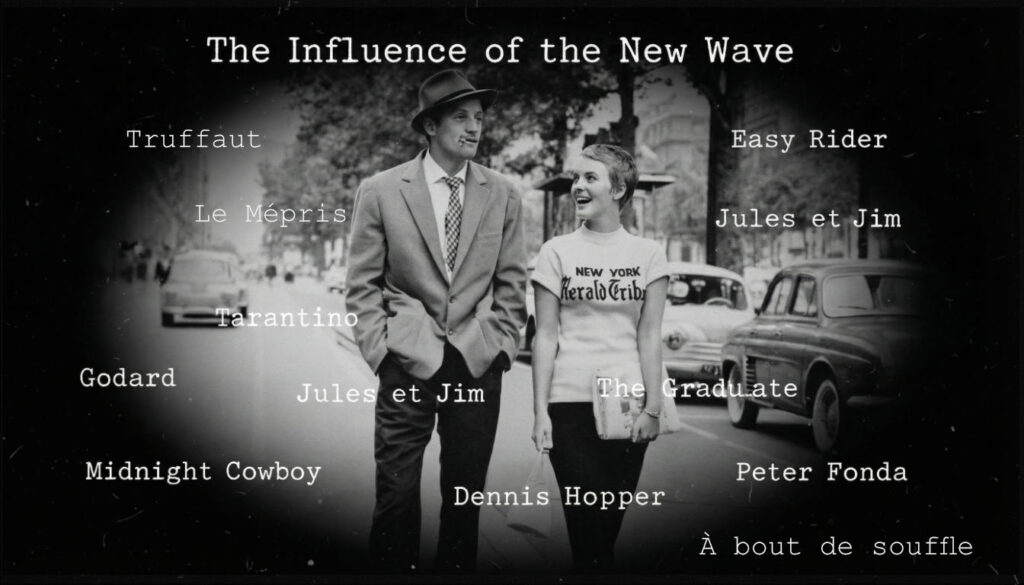
That introduction to film course opened up a world I hadn’t expected. A world beyond Hollywood and the odd Brit flick or Depardieu film. German Expressionism, Italian Neo-realism, Soviet Montage, the French New Wave. A crazy, winding route through cinema history that suddenly made everything feel connected. It was somewhere along that journey that I fell into auteur theory and the filmmakers who so defined that era. Breathless. Jules et Jim. Critics who became directors, who took the theory and made it real, and who did it by turning budget constraints into a creative philosophy.
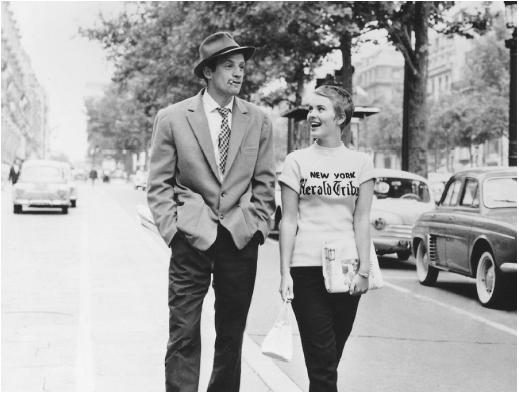
Jean-Paul Belmondo and Jean Seberg in A Bout de Souffle (Breathless)
What struck me then, and still does now, is how the New Wave happened because technology had shifted. Something that had been in the hands of a few gatekeepers was suddenly accessible to the many. Lighter cameras, faster film stocks, the streets as a studio, the jump cut. It’s a pattern that repeats. The internet did it, and AI is doing it right now. And the generation that followed, from Scorsese to Tarantino, grew up on this stuff.
And the ripples from that French revolution eventually crossed the Atlantic. By 1967, a year I’d argue represents something close to a peak moment in twentieth century creative culture, the influence had fully landed in America. Two masterpieces arrived almost simultaneously: The Graduate and Bonnie and Clyde. Such great use of music, such clever plots. The Graduate is poetry. Grateful to have had the chance to watch it at one of the reruns at the Odeon. And don’t even get me started on the bands that emerged that same year. But that’s another post altogether.
Then came Easy Rider, a film I do truly love too. So very counter-cultural, such a killer soundtrack, not to mention the way Jack Nicholson waltzed in and stole the show. Not an easy thing to do when you have Peter Fonda and Dennis Hopper up there on the screen.
The line that sticks with me most from Nouvelle Vague, delivered by Godard himself: “To be a filmmaker, you have to be either a revolutionary or a plagiarist.” What do you think? One thing you can say for certain about Tarantino is that he truly embodies both.
0 Comments on "Godard Would’ve Hated It: On Revolutionaries and Plagiarists"